
Vintage Leather Messenger Bags: The Ultimate Commuter’s Guide for Every Transit System (2026)

Why Vintage Leather Messenger Bags Still Rule the Commute in 2026
Vintage leather messenger bags have been a staple of urban commuting for decades, and in 2026 they remain one of the smartest investments a professional can make. Unlike disposable fast-fashion bags that fall apart after one rainy season, a well-made vintage leather messenger bag ages with character, develops a unique patina, and carries everything from a laptop to a packed lunch with understated style. Whether you are squeezing onto the Tokyo subway, cycling through Amsterdam’s cobblestone streets, or driving into a Chicago office park, the right vintage leather messenger bag transforms the daily grind into something you actually look forward to.
But not every transit system demands the same bag. A commuter in Copenhagen on a cargo bike needs different features than someone navigating New York’s Penn Station at rush hour. This guide breaks down exactly what to look for based on how, where, and when you commute — so you can pick the vintage leather messenger bag that fits your real life, not a fantasy photo shoot.
What Makes a Messenger Bag Vintage — And Why It Matters
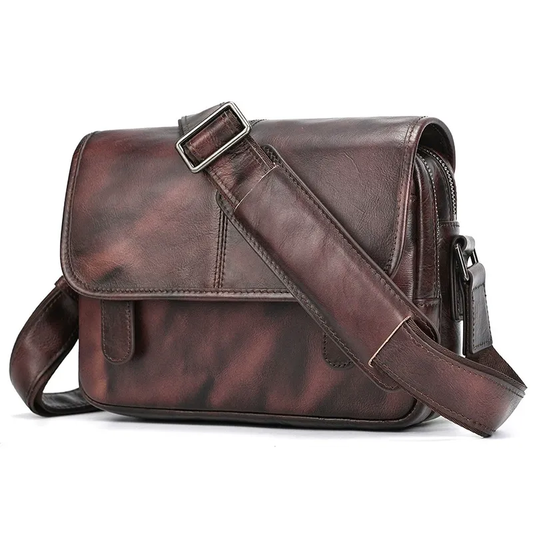
The term vintage in vintage leather messenger bags refers to both the aesthetic and the construction philosophy. Genuine vintage-style messenger bags use full-grain or top-grain leather tanned with traditional methods (vegetable tanning, oil tanning) that produce a bag with natural grain, rich color depth, and the ability to develop a patina over years of use. Unlike bonded or corrected-grain leather that peels and cracks, full-grain leather actually improves with age — scratches blend into the character rather than ruining the look.
Construction matters just as much as material. Authentic vintage leather messenger bags feature:
- Reinforced stitching at stress points (strap anchors, flap hinges, bottom corners)
- Solid brass or copper hardware that develops a natural tarnish instead of flaking chrome plating
- Riveted or double-stitched seams rather than glued construction
- A structured but not rigid body that conforms to what you carry without collapsing
- A flap that covers the entire opening with a secure closure — typically buckle, magnetic snap, or a combination
These details separate a bag that lasts three years from one that becomes a lifelong companion. And for commuters who spend an hour-plus each way in transit, that durability is not a luxury — it is a cost-per-use calculation that almost always favors quality.
Vintage Leather Messenger Bags by Transit System: What to Look For
Cycling Commuters (Amsterdam, Copenhagen, Portland, Berlin)
If you commute on two wheels, your vintage leather messenger bag needs to do more than look good strapped across your back. Cycling-specific demands include a stabilizer strap (the secondary cross-strap that keeps the bag from swinging forward when you lean into a turn), a wide main strap with a padded shoulder section, and weather resistance — because rain does not wait for you to reach the office.
Look for vintage leather messenger bags with a waxed or oiled finish rather than untreated raw leather. Waxed canvas and oil-tanned leather naturally repel light to moderate rain, and they dry without water stains. A bag with a flap that extends well past the edges of the main compartment provides extra runoff protection. For cyclists in rainy climates like the Pacific Northwest or Northern Europe, consider a messenger bag with a waterproof liner sewn inside the leather exterior — you get the vintage look with practical wet-weather performance.
Size matters on a bike. A bag that is too large catches wind, throws off your center of gravity, and bangs against your hip with every pedal stroke. Aim for 15–20 liters for a daily laptop-and-lunch carry; reserve 25+ liters for those who also haul gym clothes or groceries. And always test the stabilizer strap on a short ride before committing — a poorly designed stabilizer digs into your armpit after ten minutes.
Subway and Metro Commuters (New York, London, Tokyo, Paris, Shanghai)
Underground commuters face a different set of challenges: crowded platforms, narrow train doors, frequent bag checks, and the constant threat of pickpockets in tourist-heavy stations. For subway and metro use, vintage leather messenger bags should prioritize security and compactness over raw capacity.
The ideal subway commuter messenger bag sits flat against your body — no wider than your torso and no deeper than about 10 cm (4 inches) when empty. This lets you navigate packed carriages without accidentally whacking someone with your bag. A flap that fastens with both a buckle and a hidden magnetic snap gives you quick one-handed access at the turnstile while still deterring opportunistic hands in a crowd.
For London Underground and Paris Metro commuters specifically, pay attention to the strap length. You will climb stairs. A lot of stairs. A bag that bounces against your lower back with every step becomes exhausting by Wednesday. The strap should be adjustable enough to cinch the bag high and tight across your mid-back — not dangling at hip level like a fashion accessory. On trains like the Tokyo Yamanote Line or Shanghai Metro Line 1 where rush-hour density means standing shoulder-to-shoulder for 40 minutes, a slim profile and secure closure are non-negotiable.
Car Commuters and Park-and-Ride (Los Angeles, Houston, Atlanta, Suburban UK)
If your commute involves a car for most of the journey plus a short walk from the parking structure to the office, your vintage leather messenger bag faces lower physical stress but higher aesthetic expectations. This is the commuter who walks into a lobby, a reception area, or a client meeting with the bag still on their shoulder — so first impressions matter.
Car commuters can afford slightly larger bags (20–28 liters) since weight and aerodynamics are not constraints. A structured vintage leather messenger bag with a padded laptop sleeve and organized internal pockets lets you transition seamlessly from the driver seat to the conference room. Look for bags with a dedicated tablet sleeve and a zippered interior pocket for keys, badge, and phone — you will appreciate the organization when you are running late and digging for your ID badge at the security gate.
One underappreciated feature for car commuters: a trolley sleeve on the back panel. While more common on nylon briefcases, some vintage leather messenger bags now include a discreet pass-through strap that slides over a rolling luggage handle. If you ever combine driving with air travel for work, this feature pays for itself on the first business trip.
Multimodal Commuters (London, Berlin, San Francisco, Singapore)
A growing number of urban professionals stitch together commutes from multiple modes — bike to the station, train to the city, then a 15-minute walk to the office. Multimodal commuters need the most versatile vintage leather messenger bags because the bag must perform well across all of the above scenarios.
The sweet spot is an 18–22 liter vintage leather messenger bag with a removable stabilizer strap. You attach the stabilizer for the bike leg, detach it for the train and walking portions. The bag should have a grab handle on top (for lifting onto luggage racks and overhead bins) and a rear exterior pocket (for quick phone or transit card access without opening the main flap). Multimodal commuters in cities like Berlin, where the S-Bahn, U-Bahn, tram, and bike lanes all connect, should also look for bags with a bright interior lining — dark leather interiors swallow small items, and you will waste precious minutes groping for your earbuds at every transfer.
Check out our vintage canvas messenger bags collection for waxed canvas options that complement the leather styles perfectly for mixed-mode commuting.

Material Deep Dive: Leather Types for Commuter Messenger Bags
| Leather Type | Durability | Water Resistance | Patina Development | Best For |
|---|---|---|---|---|
| Full-Grain Vegetable-Tanned | Excellent | Low (needs treatment) | Rich, fast-developing | Car commuters, dry climates |
| Full-Grain Oil-Tanned | Excellent | Moderate | Subtle, slow | Cyclists, mixed weather |
| Top-Grain (Sanded/Corrected) | Good | Moderate | Minimal | Budget-conscious subway commuters |
| Waxed Canvas + Leather Trim | Very Good | High | Fabric ages; leather trim patinas | Cyclists, rainy climates |
| Bonded Leather | Poor | Low | None — peels instead | Avoid for any serious commuting |
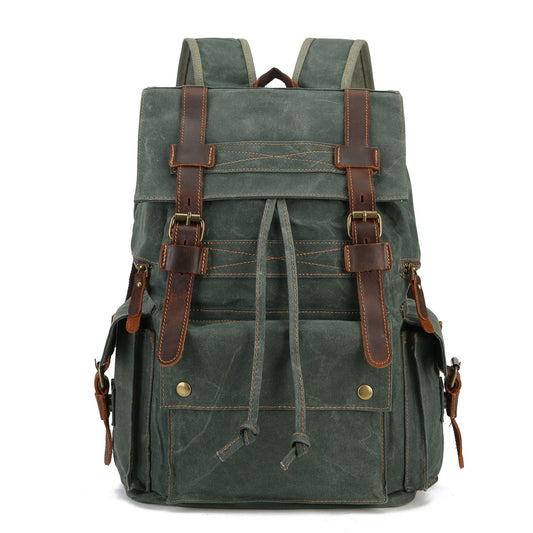
For most commuters, full-grain oil-tanned leather is the Goldilocks choice: it resists light rain without babying, develops character slowly enough that you do not panic over every scratch, and costs less than vegetable-tanned options of equivalent quality. If you commute primarily by car in a dry climate (Phoenix, Madrid, Los Angeles), vegetable-tanned leather rewards you with the most dramatic patina. If you cycle year-round in London or Vancouver, strongly consider a waxed canvas bag from our waxed canvas bags collection with leather accents — you keep the vintage aesthetic while gaining real weather protection.
Size and Organization: What Actually Fits Inside
A common mistake first-time vintage leather messenger bag buyers make is overestimating interior volume. Leather construction means thicker walls than nylon, so a 20-liter leather messenger bag often holds about as much as a 16-liter nylon backpack. Here is a realistic breakdown of what fits at each size tier:
- 12–15 liters: 13-inch laptop, notebook, phone, wallet, small water bottle, light jacket or scarf. Ideal for subway commuters who carry minimal gear.
- 18–22 liters: 15-inch laptop, tablet, notebook, lunch container, water bottle, light sweater, chargers, and a paperback. The sweet spot for most professionals.
- 25–30 liters: Everything above plus gym clothes, shoes, a packed lunch, and a DSLR camera. Better for car commuters or those with a locker at the office.
Internal organization matters more than total capacity. A 22-liter bag with one cavernous compartment is less useful than an 18-liter bag with a padded laptop sleeve, two zippered pockets, pen slots, and a key clip. When evaluating vintage leather messenger bags, open the main compartment and ask: can I find my phone, keys, and transit pass within three seconds without looking? If the answer is no, keep shopping.
Strap Comfort: The Feature You Will Notice Every Single Day
No feature of a vintage leather messenger bag matters more day-to-day than the shoulder strap. A poorly designed strap turns a beautiful bag into a pain in the neck — literally. The strap should be at least 3.8 cm (1.5 inches) wide across the shoulder contact area, with a padded or articulated section that distributes weight evenly. Thin straps concentrate pressure into a narrow band that digs into your trapezius muscle after 20 minutes of walking.
For commuters carrying heavy loads (laptops, textbooks, multiple devices), look for straps with a cotton or neoprene shoulder pad that slides independently of the main strap. This lets the pad stay in place on your shoulder while the bag and strap shift as you move — a small mechanical detail that makes an enormous comfort difference over a one-hour commute. Also check the strap attachment points: they should be reinforced with rivets or box stitching, not just a single line of thread. A strap failure during a commute is a catastrophic inconvenience that quality vintage leather messenger bags should never experience.
Weatherproofing for Commuters: Regional Considerations
Different commuting climates demand different levels of weather protection from vintage leather messenger bags. In consistently wet cities (Seattle, London, Singapore, Mumbai during monsoon), no amount of leather treatment will match the performance of a bag with a waterproof liner or a waxed exterior. If you live in one of these cities and insist on leather, choose oil-tanned leather conditioned quarterly with a beeswax-based waterproofing balm.
In dry, hot climates (Dubai, Phoenix, Madrid), the primary threat is not water but UV radiation and heat. Direct sunlight fades leather and dries out the natural oils that keep it supple. Store your bag out of direct sun when not in use, condition it every two months, and avoid leaving it in a hot car — temperatures above 60 Celsius (140 Fahrenheit) inside a parked vehicle can permanently damage leather fibers.
In cities with four distinct seasons (Chicago, Berlin, Toronto, Beijing), your vintage leather messenger bag needs to handle snow, slush, road salt, summer downpours, and everything in between. A bag with a water-resistant treatment and metal feet on the bottom (to keep it elevated off wet ground when set down) handles year-round commuting best. For a professional alternative in harsher weather, browse our genuine leather briefcases collection, which offers structured options with similar vintage character.

FAQ: Vintage Leather Messenger Bags for Commuters
How much should I spend on a vintage leather messenger bag?
A quality vintage leather messenger bag that will last 5–10 years of daily commuting typically costs between $150 and $400 USD. Below $100, you are almost certainly buying bonded or low-grade corrected-grain leather that will peel within two years. Above $500, you are paying for brand prestige or exotic leathers rather than proportionally better construction. The $200–300 range is the value sweet spot for full-grain leather with solid hardware.
Can I carry a vintage leather messenger bag in the rain?
Yes, if it is made from oil-tanned leather or treated with a waterproofing balm. Light to moderate rain will bead and roll off a properly conditioned bag. Heavy, sustained downpours will eventually saturate even treated leather, so commuters in very rainy cities should either choose a waxed canvas option or carry a compact rain cover. Never dry a wet leather bag near a radiator or with a hair dryer — let it air-dry at room temperature, then condition it once fully dry.
How do I clean and maintain a vintage leather messenger bag?
Wipe the exterior with a barely damp cloth every few weeks to remove urban grime. Condition with a leather balm or cream every 2–3 months (more often in dry climates, less in humid ones). Avoid saddle soap for routine cleaning — it is too harsh for finished leather. For stains, blot (do not rub) with a dry cloth, then treat with a leather-specific cleaner. A well-maintained vintage leather messenger bag should look better at year five than it did new.
Are vintage leather messenger bags too heavy for daily commuting?
A full-grain leather messenger bag in the 18–22 liter range typically weighs 1.2–1.8 kg (2.6–4.0 lbs) empty. Add a laptop, charger, and lunch, and your total carry is 4–6 kg. For comparison, a nylon backpack of similar capacity weighs about 0.6–0.9 kg empty. The weight difference is real, but most commuters find the durability, aesthetics, and aging character of leather worth the extra mass. If weight is a primary concern, look for bags with thinner (but still full-grain) leather in the 1.5–2.0 mm range rather than heavy 2.5+ mm leather.
Conclusion: Choose the Vintage Leather Messenger Bag That Fits Your Commute
Vintage leather messenger bags are not a one-size-fits-all category. The bag that works perfectly for a car commuter in Atlanta may be a daily frustration for a cyclist in rainy Amsterdam. By matching your bag’s material, size, strap design, and weather protection to your actual transit system and climate, you turn a simple purchase into a decade-long investment that looks better every year.
Start with your commute: are you on a bike, a train, in a car, or mixing all three? Then choose the leather type and interior organization that supports your daily carry. A well-chosen vintage leather messenger bag is not just a bag — it is the one piece of gear you interact with more than any other object in your professional life. It deserves the thought.