School Backpack vs Travel Backpack: Fit Guide 2026 – Woosir Skip to content

10% OFF on Your First Order, coupon code: WS10

School Backpack vs Travel Backpack: Fit, Comfort and Safe Load Limits for 2026

by Woosir Editorial Team 20 Aug 2026 0 comments
School desks with stationery and student backpacks in a classroom

The school backpack vs travel backpack question usually gets answered with a feature list — laptop sleeves, water bottle pockets, capacity in litres. That misses the part your spine cares about. The real difference between these two categories is how they move weight from the bag onto your body, and that single engineering decision explains why a 9 kg school bag can leave your shoulders aching after a twenty-minute walk while a 14 kg travel pack feels manageable for an hour.

This guide approaches the comparison through fit, comfort and safe load limits. You will learn how much weight is genuinely safe to carry, why torso length matters more than your height, how to adjust a harness in the correct order, and which of the two designs is the better buy for your actual life stage. By the end, choosing between them should feel obvious rather than arbitrary.

School Backpack vs Travel Backpack: What Each Is Engineered to Do

A school backpack is optimised for frequent, short carries and constant access. You put it on and take it off perhaps a dozen times a day, so it prioritises grab-and-go simplicity: a wide main compartment, front organiser pockets, a padded laptop sleeve and lightly padded shoulder straps. Its load path is simple and vertical — weight hangs from your shoulders, full stop.

A travel backpack is optimised for longer, heavier carries and secure transport. It expects to be worn for thirty to ninety minutes at a stretch, often at higher weight, so it adds a load-transfer system: a structured back panel or frame sheet, load-lifter straps, a sternum strap and a genuine padded hip belt. Its job is to move most of the weight off your shoulders and onto your pelvis, which is far better suited to bearing it.

That is the crux. School bags manage weight. Travel bags redirect it.

Feature School backpack Travel backpack
Typical capacity 18–30 L 30–45 L
Comfortable load 4–8 kg 10–16 kg
Back panel Foam padding Frame sheet or structured panel
Hip belt Absent or token webbing Padded, load-bearing
Load lifters Rare Standard
Opening style Top-loading Often clamshell / panel-loading
Laptop sleeve Usually base-resting Usually suspended
Wear duration 10–25 minutes per carry 30–90 minutes per carry
Security features Minimal Lockable zips, hidden pockets

How Much Weight Is Actually Safe to Carry?

This is where most buying advice goes silent, and it is the most consequential part of the decision.

The 10–15% Guideline

The widely cited ergonomic guidance is that a loaded backpack should not exceed 10% to 15% of the wearer's body weight for routine daily carrying. For younger students the conservative end applies; for healthy adults with a properly fitted hip belt, the upper end is reasonable, and experienced hikers regularly exceed it with trained conditioning and a proper suspension system.

The number matters less than the principle: your safe load is a function of your body, not the bag's capacity. A 45 L pack does not entitle you to 20 kg.

What Overloading Actually Does

When a pack is too heavy or hangs too low, your body compensates predictably. You lean forward from the hips to move your centre of gravity back under the load, which flattens the natural curve of the lower spine and loads the lumbar discs unevenly. Your shoulders roll forward, the trapezius muscles stay contracted to resist the strap pressure, and over months that becomes neck tension and upper-back fatigue.

Strap pressure has a second effect people rarely connect to their bag: narrow, thinly padded straps concentrate force over the brachial plexus near the top of the shoulder, which is why heavy school bags sometimes produce tingling or numbness down the arm. Wider, contoured straps spread the same load across far more area.

Real Numbers by Body Weight

Body weight Conservative limit (10%) Upper limit (15%) Practical guidance
40 kg 4.0 kg 6.0 kg Younger student — stay near 10%
55 kg 5.5 kg 8.3 kg School bag territory
70 kg 7.0 kg 10.5 kg Hip belt needed above ~8 kg
85 kg 8.5 kg 12.8 kg Travel pack strongly preferred

Notice where the categories separate. Above roughly 8 to 9 kg, a bag without a load-bearing hip belt has no mechanism to protect your shoulders, no matter how thick its padding is. That threshold — not litres — is the honest dividing line between a school backpack and a travel backpack.

Fit Starts With Torso Length, Not Your Height

Backpacker walking through a vibrant city street with a travel backpack

Two people of identical height can need different pack sizes, because torso length varies independently of leg length. Getting this wrong is the most common reason an expensive pack feels worse than a cheap one.

How to Measure Your Torso

Tilt your head forward and find the bony bump at the base of your neck — the C7 vertebra. That is the top. Then place your hands on your hip bones with thumbs pointing backward; the imaginary line between your thumbs across your lower back is the bottom. Have someone measure the distance along the curve of your spine between those two points.

  • Under 41 cm (16"): extra-small / short
  • 41–46 cm (16–18"): small
  • 46–51 cm (18–20"): medium / regular
  • Over 51 cm (20"): large / tall

Many quality travel packs offer an adjustable harness that slides across a range, which is genuinely useful if you fall near a boundary or are buying for a growing teenager.

Adjust in the Right Order

Most people tighten the shoulder straps first, which is exactly backwards and guarantees the weight stays on their shoulders. Load the pack to realistic weight, then work through this sequence.

  • Loosen everything before you put the pack on.
  • Set the hip belt first. Centre its padding over your hip bones — not on your waist above them — and tighten firmly. This should take most of the load.
  • Snug the shoulder straps until they contour to your shoulders without lifting the hip belt. They stabilise; they do not carry.
  • Set load lifters to roughly a 45-degree angle upward from the top of your shoulder to the pack body. Small adjustments here dramatically change how far the load sits from your spine.
  • Fasten the sternum strap across the chest, a few centimetres below the collarbone, and tighten only lightly — it stops the straps sliding outward and should never restrict breathing.
  • Re-check the hip belt after five minutes of walking; belts settle.

The Gap Test

Slide a flat hand between the pack and your upper back. A well-fitted pack sits close, with the load hugging your body. If there is a large gap, or if the pack's weight visibly pulls away from your shoulders, the torso length is wrong or the load lifters need attention. Distance from your spine multiplies the effective leverage of the weight — a load carried 10 cm further out feels substantially heavier.

Why School Backpacks Feel Worse Under Load Than Travel Backpacks

Return to the school backpack vs travel backpack comparison with fit knowledge in hand and the reasons become concrete rather than vague.

First, there is no load path to the hips. Everything routes through two shoulder anchors. Second, top-loading school bags let contents settle into the bottom of the bag, which pulls the load low and away from the shoulder blades — the worst possible position for leverage. Third, most school bags have no frame sheet, so a heavy textbook can press its corner directly into your back and the whole bag sags into a curve that no longer matches your spine.

Travel packs solve each of these. The frame sheet keeps the panel flat and transfers vertical load down to the belt. Panel loading holds contents in place instead of letting them slump. Load lifters pull the top of the pack toward you. None of this is exotic engineering — it is simply absent from bags designed for a ten-minute walk between classrooms.

Packing for Comfort, Not Just Capacity

How you load a bag changes its felt weight more than most people believe, and the rules are identical for both categories.

  • Heaviest items against your back, at mid-height. Laptops and thick books belong in the sleeve closest to your spine, centred between your shoulder blades and your waist.
  • Medium items in the outer main compartment. Clothing, lunch, a folded jacket.
  • Light and bulky at the bottom. A soft layer at the base cushions without adding leverage.
  • Frequently used small items in lid or front pockets. Reducing how often you dig through the main compartment reduces how often you take the bag off entirely.
  • Fill dead space. A half-empty bag lets contents shift with each step, and shifting weight is fatiguing.
  • Balance side pockets. A full water bottle on one side only introduces a persistent sideways pull.

One further habit matters for students: audit the bag weekly. School bags accumulate. Books that are no longer on the timetable, old folders and forgotten sports kit routinely add two or three kilograms of pure dead weight that never gets noticed because it arrived gradually.

Laptop and Tech Protection Compared

Both categories carry laptops, but they protect them differently. School backpacks typically place the sleeve against the back panel, extending down to the base of the bag. Set that bag down firmly and the impact travels straight through the base seam into the corner of your laptop.

Better designs — common in travel packs and in the stronger school bags — suspend the sleeve so it stops two to three centimetres above the base, leaving a crumple zone. Look for a sleeve with a soft lining, a retention strap, and padding on both faces rather than only the outer one. For anyone carrying a machine daily, a suspended sleeve is worth more than an extra pocket.

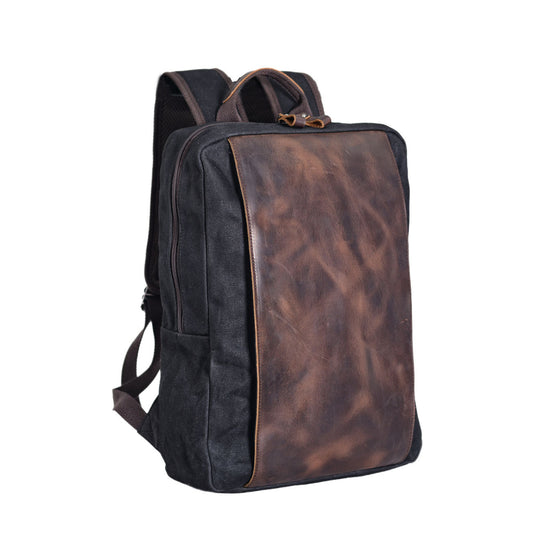
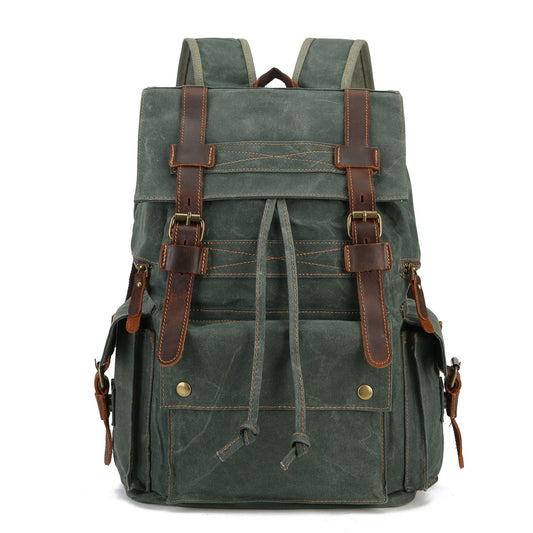
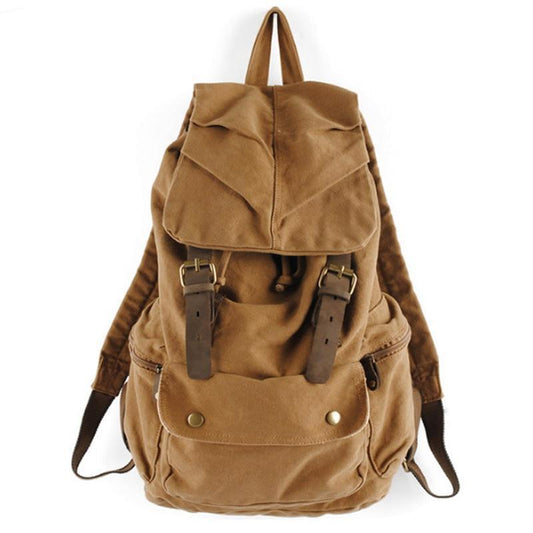
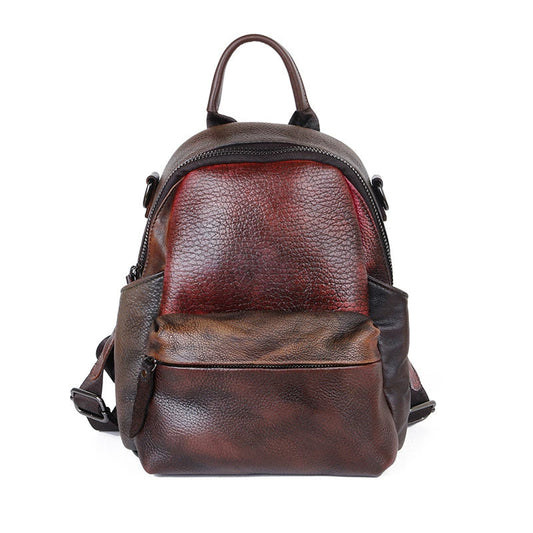
If you want a bag that reads as professional rather than institutional while still protecting tech, the canvas and leather backpack range sits neatly between the two categories — structured enough for daily laptop duty, understated enough for an office or lecture hall.

Regional Context: Commutes Are Not the Same Everywhere

Europe

Long station walks, stairs at older metro stops and frequent cycling mean bags are worn actively rather than carried short distances. A sternum strap stops the bag swaying on a bike, and a slim profile matters in crowded train aisles. Compact travel packs in the 30–35 L range are popular precisely because they handle both a commute and a weekend trip.

Asia

Dense rush-hour transit rewards a narrow bag you can swing to your front, plus zips you can keep in view. Heat and humidity make back-panel ventilation a genuine comfort feature rather than a marketing line — mesh channels and raised foam ridges make a noticeable difference on a humid platform. Lighter loads and a compact footprint usually beat maximum capacity.

The Americas

Longer distances, more driving and large campuses shift the priorities toward capacity and durability over compactness, since bags are often loaded once and carried across a wide site. Students walking substantial distances between buildings benefit most clearly from a hip belt, which is why hybrid campus packs with removable belts have gained ground. For weekend hiking on top of that, a proper hiking backpack remains the better tool than stretching a school bag beyond its design.

Durability and Cost Per Year

Travel packs generally cost more and last longer, largely because they are built for heavier loads with reinforced anchor points, heavier fabric and better zippers. Comparing purchase price alone hides that gap.

Category Typical price Realistic lifespan Cost per year
Budget school backpack $35 1–2 school years ~$23
Quality canvas daypack $95 5–7 years ~$16
Travel backpack 35–40 L $180 8–12 years ~$18
Leather-trimmed daily pack $210 10–15 years ~$17

The annualised figures converge, which is the useful insight: at the budget end you are not saving money, you are deferring the same spend into repeated replacements. For anyone who wants one bag to cover several years of study and travel, the genuine leather backpacks and heavier canvas options make more financial sense than their sticker prices suggest.

Which Should You Buy? A Guide by Life Stage

  • Primary and middle school: A school backpack, sized small, with wide contoured straps and a sternum strap. Keep loads near 10% of body weight and audit contents weekly.
  • High school with heavy books: A larger school backpack with a frame sheet and, ideally, a removable hip belt. This is the group most often carrying unsafe weight.
  • University commuter: A 25–30 L structured daypack with a suspended laptop sleeve. Comfort over 30-minute walks matters more than maximum capacity.
  • Student who also travels: A 35 L travel backpack that meets most carry-on limits. One bag genuinely covers lectures, flights and weekends.
  • Working professional: A leather or canvas-and-leather pack with a suspended sleeve. Prioritise looking appropriate and protecting tech; loads are rarely heavy.
  • Regular hiker or long-haul traveller: A dedicated travel or hiking pack with a full suspension system. Do not compromise here — this is where load transfer earns its keep.

Frequently Asked Questions

Can I use a school backpack as a travel backpack?

For a one or two-night trip with a light load, yes. Beyond about 8 kg, or for carries longer than half an hour, the lack of a load-bearing hip belt and frame sheet becomes the limiting factor and shoulder fatigue sets in quickly. A school bag is a capable overnight bag and a poor multi-week one.

How heavy should a school backpack be?

Aim for no more than 10% to 15% of the wearer's body weight, with younger students at the lower end. For a 50 kg student that is roughly 5 to 7.5 kg fully loaded. Weighing the packed bag on a bathroom scale once a term is the simplest way to keep it honest.

Does a hip belt really make that much difference?

Yes, and it is the largest single comfort variable at higher loads. A properly positioned padded hip belt can shift a substantial share of the pack's weight from your shoulders to your pelvis, which is structurally far better suited to carrying it. Token webbing belts without padding do not achieve this.

What capacity should I choose for one-bag travel and study?

Around 35 litres is the sweet spot. It is large enough for a week of clothes plus a laptop, small enough to satisfy most airline carry-on dimensions, and not so large that you are tempted into unsafe weight. Above 45 L, the bag encourages overpacking more than it enables it.

Are top-loading or clamshell backpacks better?

Clamshell openings are better for travel because they let you pack in layers, see everything at once, and keep contents from settling to the bottom. Top loaders are quicker for grab-and-go access during a school day. Choose based on how often you need to reach the middle of the bag.

How do I stop my backpack straps digging into my shoulders?

Check three things in order: reduce total weight, tighten the hip belt so the shoulders are stabilising rather than carrying, and confirm the torso length is correct so the straps contour rather than bridge. If straps still dig in, they are likely too narrow or too thinly padded for the load you are carrying.

The Bottom Line

The honest answer to school backpack vs travel backpack is that they are not competitors — they are tools calibrated for different weights and durations. Below about 8 kg and twenty-minute carries, a well-fitted school backpack with wide straps and a suspended laptop sleeve is genuinely the better, lighter, more convenient choice. Above that threshold, or for carries measured in hours, only a travel backpack's frame sheet, load lifters and padded hip belt will keep the weight off your shoulders.

Measure your torso, weigh your loaded bag, adjust the harness from the hips upward, and buy for the heaviest load you carry regularly rather than the lightest. Fit correctly and load sensibly, and either category will serve you comfortably for years — while the wrong pairing of bag and weight will quietly cost you comfort every single day.

New Arrival

Best Sellers

Close
Edit Option
Close
Notify Me
Close
Login Close
My Cart (0) Close