Backpack Duffle vs Wheeled Duffle: 2026 Guide – Woosir Skip to content

10% OFF on Your First Order, coupon code: WS10

Backpack Duffle vs Wheeled Duffle: Which Convertible Bag Wins in 2026?

by Woosir Editorial Team 12 Aug 2026 0 comments
Backpack Duffle vs Wheeled Duffle: Which Convertible Bag Wins in 2026?

A backpack duffle and a wheeled duffle solve the same problem in opposite ways. Both promise to carry a week of clothing without forcing you into a rigid suitcase. One asks your shoulders to do the work and gives you total freedom over terrain. The other hands the load to two wheels and a telescoping handle, and asks you to stay on smooth ground. Choosing badly costs you either a sore back at the end of every travel day or a bag you end up dragging up three flights of stairs in a building with no lift.

This guide settles the backpack duffle vs wheeled duffle debate with the variables that actually decide it: total packed weight, the surfaces you will cross, airline sizing rules, and how long you have to carry the bag between transport links. By the end you will know which convertible bag fits your travel pattern, what to inspect before you buy, and how to pack so the bag performs the way it was designed to.

What a Backpack Duffle Actually Is

The category name gets used loosely, so it is worth drawing a hard line. A true convertible bag has two fully engineered carry modes, not one real mode and one emergency mode.

The backpack duffle

A backpack duffle is a barrel or rectangular duffle body with a stowable backpack harness on one face. Grab the top handles and it behaves like a classic holdall. Unzip the back panel, pull out the shoulder straps and hip belt, and it becomes a rucksack. The best examples add a padded back panel, load-lifter straps at the top of the shoulder harness, and a sternum strap. The worst examples staple two flat webbing loops onto a soft-sided bag and call it a hybrid.

The advantage is total terrain independence. Stairs, gravel, sand, cobblestones, muddy trailheads, crowded night markets, chicken buses, ferry gangplanks — none of it matters. Your hands stay free, which is more valuable than most travelers realise until they are holding a passport, a coffee and a phone at the same time.

The wheeled duffle

A wheeled duffle keeps the soft, expandable duffle body but bolts a wheel housing and an aluminium telescoping handle to the base. It is not a hard-shell suitcase: the fabric still flexes, so you can overstuff it, squash it into a car boot, and stack things on top. But the chassis adds structure and rigidity along the base.

The advantage is that packed weight becomes almost irrelevant on smooth surfaces. Twenty-two kilograms rolls as easily as eight. For anyone with back or shoulder issues, or anyone travelling with camera gear, tools, sample cases or sports equipment, that is decisive. Browse the duffle bags with wheels collection to see how the chassis is integrated on well-built models.

Backpack Duffle vs Wheeled Duffle: The Head-to-Head Comparison

Factor Backpack Duffle Wheeled Duffle
Empty weight 0.9-1.8 kg (2-4 lb) 2.3-4.1 kg (5-9 lb)
Usable capacity per litre Near 100% - no chassis intrusion 85-90% - wheel wells eat volume
Stairs and kerbs Effortless Carry by side handle, awkward
Cobblestones and gravel No impact Loud, slow, hard on wheels
Comfortable packed weight ceiling 11-13 kg (24-29 lb) for most adults Effectively unlimited on smooth ground
Long airport concourses Tiring after 15-20 minutes Easy indefinitely
Hands free Yes No
Failure points Zippers, strap anchors Wheels, bearings, handle tubes
Overhead bin fit at max size Compresses to fit Rigid base limits squeeze
Best trip length 2-10 days 5 days to several weeks

Read that table twice and a pattern emerges. The backpack duffle trades weight capacity for terrain freedom. The wheeled duffle trades terrain freedom for weight capacity. Everything else is detail.

The Weight Threshold That Decides It for Most Travelers

The 12 kg rule of thumb

Load-carriage research and decades of military and hiking practice converge on a similar figure for untrained carriers: comfortable sustained load sits somewhere around 15-20% of body weight for short periods, and closer to 10-12% for long, repeated stretches. For a 70 kg adult that means roughly 10-14 kg before the harness stops feeling supportive and starts feeling like punishment.

Twelve kilograms is a useful line in the sand. If your typical packed bag lands under it, a backpack duffle is almost always the better buy. If you routinely exceed it — because you carry work equipment, winter clothing, gifts, or you simply prefer to pack fully — wheels will make you happier, and no amount of harness padding changes that arithmetic.

What your back is really carrying

The number that matters is not the bag weight but the moment arm. A duffle body is wide and shallow, so its centre of mass sits further from your spine than a purpose-built hiking pack of the same volume. That means a 12 kg backpack duffle can feel like a 14 kg trekking pack. Load-lifter straps exist specifically to pull the top of the bag toward your shoulders and shorten that lever. If a backpack duffle has no load lifters, mentally subtract two kilograms from its comfortable ceiling.

Hip belts matter for the same reason. A padded, structured hip belt transfers 40-60% of the load onto your pelvis. A thin webbing strap transfers close to nothing and functions only as a stabiliser. When you compare two backpack duffles at similar prices, the one with a real hip belt is worth more than the one with an extra litre of capacity.

Terrain: Where Each Bag Wins Around the World

Europe: cobblestones, stairs and old-town streets

Historic European centres are structurally hostile to wheels. Lisbon's Alfama, Prague's Malá Strana, Rome's Trastevere, Edinburgh's Old Town and much of Kraków, Dubrovnik and Bruges are paved in setts and cobbles that vibrate small wheels to destruction and broadcast your arrival to the entire street at two in the morning. Add the reality that a large share of pre-war apartment buildings and budget guesthouses have no lift, and the backpack duffle wins outright for anyone whose trip is weighted toward old towns.

The counterweight is Europe's excellent rail network. If your itinerary runs city centre to city centre on trains with step-free access and you are staying in modern hotels, wheels are perfectly viable and much kinder over long station concourses like Berlin Hauptbahnhof or Paris Gare du Nord.

Asia: crowded transit, narrow lanes and humidity

In Tokyo, Seoul, Hong Kong and Singapore, station infrastructure is superb but crowd density is extreme. A wheeled bag in a rush-hour carriage is a liability — it rolls into other passengers, blocks doorways, and you cannot easily lift it above the crowd. A backpack duffle worn on the front of your body in a packed train is a well-established technique that keeps your footprint small and your bag under your eyes.

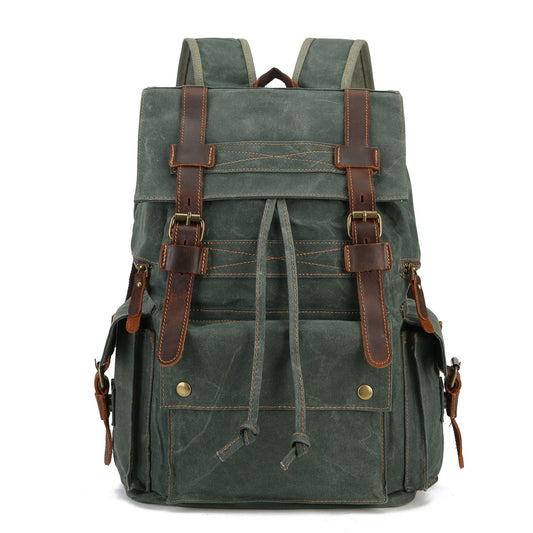
Across Southeast Asia the calculation is even clearer: unsealed lanes, high kerbs, boat transfers, and long-tail taxis reward a bag you can throw over one shoulder. Humidity is the other factor. Sustained tropical damp punishes untreated leather and stitched wheel housings alike; a waxed cotton or coated fabric body dries faster and resists mildew better. The waxed canvas bags collection covers the material end of that problem.

The Americas: long concourses, road trips and trailheads

North American travel skews toward vast airports, rental cars and hotels with lifts and kerb-cut parking. Atlanta, Dallas-Fort Worth and Denver involve genuinely long walks between gates. That environment favours wheels, and a wheeled duffle slides into a car boot far more forgivingly than a hard suitcase.

South and Central America invert it again. Uneven pavements, bus terminals, ferry docks and hostel stairs in Cusco, Cartagena or Antigua all reward a carried bag. If your trip mixes both — a work leg in Chicago followed by two weeks in Patagonia — the backpack duffle is the safer single purchase, because it never becomes unusable, it only becomes tiring.

Airlines, Carry-On Limits and the Wheel Penalty

Cabin allowances are converging around 55 x 40 x 20-23 cm across most full-service carriers, with budget airlines running tighter and enforcing more aggressively. Two structural facts should shape your choice.

  • Wheels count toward the measured dimensions. Most published limits are for the bag including wheels, handles and feet. A wheeled duffle advertised at 55 cm often measures 57-58 cm to the top of the retracted handle, which is exactly the kind of margin a sizer frame catches.
  • Soft bags cheat the sizer, rigid bases do not. A backpack duffle that is 2 cm too deep can be compressed into the frame. A wheeled duffle with a moulded chassis cannot.
  • Wheels cost you 2-4 kg of your weight allowance. On carriers with a 7 kg or 10 kg cabin limit, that is 20-40% of your allowance spent on the chassis before you pack a single shirt.
  • Backpack straps must stow. Some carriers and most conveyor systems dislike loose webbing. A back panel that zips fully over the harness protects the straps and avoids gate-side arguments.

The practical conclusion: for strict carry-on-only travel, especially on low-cost European and Asian carriers, the backpack duffle has a meaningful structural advantage. For checked-bag travel where you are packing to the 23 kg limit, the wheeled duffle is the obvious answer.

Harness Quality: What Separates a Real Hybrid From a Duffle With Straps

This is where most disappointing purchases go wrong. Inspect these five things before you commit.

1. Strap anchor points

Shoulder straps should anchor into a reinforced yoke that spreads load across the back panel, ideally bar-tacked through a webbing plate rather than sewn directly into single-layer fabric. Press the anchor between your fingers: you should feel multiple layers.

2. Back panel structure

A good backpack duffle has either a foam sheet or a light internal framesheet in the back panel. Without it, hard objects inside the bag press directly into your spine and the load sags into a hammock shape.

3. Load lifters and sternum strap

Load lifters should leave the top of the shoulder strap at roughly a 45-degree angle when the bag is worn. If they sit flat or point downward, the harness is too long for your torso and the geometry cannot work.

4. Hip belt attachment

The belt should attach at the base of the back panel, not halfway up the side of the bag. Side-mounted belts pull the bag away from your body under load.

5. Stow-away execution

The harness should disappear cleanly under a zipped flap. Test the zip with the straps stuffed inside — a panel that only closes when the straps are folded perfectly will not survive real use.

You can see how these details are handled across styles in the backpack duffle bag collection, where the harness is treated as a primary carry mode rather than an afterthought.

Wheels, Handles and the Failure Points Nobody Checks

If you go the wheeled route, understand what breaks and in what order.

  • Wheel diameter is the single best predictor of durability. Wheels under 50 mm rattle, snag on expansion joints and wear quickly. 65-80 mm wheels roll over kerbs, tram tracks and gravel with far less shock loading.
  • Sealed bearings beat plain bushings. Grit is what kills wheels. Sealed units cost more and last several times longer.
  • Handle tube count matters. Two-tube telescoping handles resist twisting far better than single-tube designs, which develop side-to-side play within a year of hard use.
  • Check whether wheels are replaceable. Bolted wheel housings can be serviced. Riveted or heat-welded housings cannot, which means one broken wheel retires the whole bag.
  • Skid plates protect the base. Without them, the underside abrades every time you drag the bag over a kerb.

Backpack duffles fail differently and more gracefully. The usual culprits are zipper sliders and stitching at high-stress corners. Both are repairable by any competent cobbler or bag repair shop, which is a genuine long-term advantage: a broken zip is a forty-minute fix, a collapsed handle tube usually is not.

large wheeled weekender bag

Materials: Waxed Canvas, Full-Grain Leather and Coated Fabrics

Material choice shifts the balance between the two formats more than most buyers expect, because it changes empty weight.

Material Weight Water resistance Ages well Best format
Waxed cotton canvas (14-24 oz) Medium High, renewable with re-waxing Excellent - develops patina Either
Full-grain leather Heavy Moderate, needs conditioning Outstanding Backpack duffle under 40L
Untreated cotton canvas Light Low Good Backpack duffle
Coated ballistic nylon Light Very high Functional, not characterful Wheeled duffle

A full-grain leather duffle is a beautiful object, but a 45-litre leather body can weigh 3 kg empty. Add wheels and you are at 6 kg before packing. That is why heritage leather works best in the sub-40-litre backpack duffle format, where the empty weight penalty stays manageable and the bag becomes a lifetime piece. The wider duffle bag collection shows the trade-off across capacities.

Which One Should You Buy? A Decision Framework

Match yourself to the closest profile.

  • Carry-on-only flyer, 2-6 day trips, budget airlines: backpack duffle, 35-40 litres. The soft body and weight saving are decisive.
  • Rail-based European city tour, mid-range hotels: wheeled duffle if you are staying central and lift-equipped, backpack duffle if old towns and guesthouses feature heavily.
  • Southeast Asia, Latin America or any multi-transport itinerary: backpack duffle, no serious contest.
  • Business travel with equipment, samples or a heavy laptop kit: wheeled duffle. Save your shoulders for the working day.
  • Gym-to-airport dual use: backpack duffle, 30-40 litres. Wheels are dead weight in a locker room.
  • Family travel where you carry a child or a second bag: wheeled duffle for the main load, so your hands and back stay available.
  • Existing back, shoulder or neck injury: wheeled duffle, with a 65 mm+ wheel set. Do not let a packing philosophy override your physiotherapist.
  • You genuinely do both: buy the backpack duffle. It is never impossible to use, only occasionally uncomfortable. A wheeled duffle on a staircase is genuinely unusable.

Packing Strategies That Change the Answer

How you pack can move a bag across the comfort threshold.

In a backpack duffle, weight should sit high and close to your spine — the opposite of hiking pack advice, because you are usually walking on flat ground rather than scrambling. Put shoes and toiletries at the base end that will sit lowest when worn, dense clothing against the back panel, and light bulky items at the outer face. Compression cubes are worth their weight here because a duffle body has no internal structure to stop contents shifting into a sag.

In a wheeled duffle, put the heaviest items directly over the wheel axle. Weight forward of the axle makes the bag tip toward you every time you stop. Weight far behind it increases the pull force on your wrist and shoulder, which is how people give themselves a rolling-bag shoulder strain on a long concourse.

For both formats, keep a hard rule: anything you need at security, on the plane or within the first hour of arrival lives in an external pocket. Digging through a duffle in a boarding queue is how items get left behind.

Care and Longevity

A backpack duffle needs very little. Brush off dirt, spot-clean with cold water and mild soap, air-dry away from direct heat, and re-wax a waxed canvas body every 12-24 months depending on exposure. Condition leather trim twice a year. Lubricate zippers with a wax stick or graphite if they start to catch — never oil, which attracts grit.

A wheeled duffle needs active maintenance. Wipe grit off wheel housings after gravel or beach exposure, check housing bolts every few trips, extend and retract the handle fully a dozen times a year to keep the locking mechanism free, and never lift the loaded bag by the telescoping handle. That last habit is responsible for more handle failures than anything else.

Frequently Asked Questions

Is a backpack duffle better than a wheeled duffle for carry-on travel?

Usually yes. A backpack duffle is 2-4 kg lighter empty, has no rigid chassis, and can be compressed into a sizer frame. On airlines with 7-10 kg cabin weight limits, that weight saving translates directly into more packing allowance.

How much can you comfortably carry in a backpack duffle?

Most adults are comfortable up to 11-13 kg for walks of 20-30 minutes, provided the bag has load lifters and a structured hip belt. Above that, the wide duffle geometry starts pulling the load away from your spine and fatigue rises sharply.

Do wheeled duffles work on cobblestones?

Poorly. Small wheels catch in the gaps between setts, the vibration is uncomfortable and noisy, and repeated shock loading shortens bearing life. Wheels of 65 mm or larger cope far better, but a carried bag is still the superior choice for old-town travel.

What size backpack duffle should I buy?

For carry-on-only travel, 35-40 litres. For checked one-week trips, 50-60 litres. For gym and overnight use, 25-35 litres. Sizes above 60 litres are difficult to carry as a backpack once fully loaded.

Can you check a backpack duffle as hold luggage?

Yes, and you should stow the harness first. Loose straps snag on baggage conveyors, which is the most common cause of torn strap anchors. A zip-away back panel solves this completely.

Are convertible bags a compromise on both fronts?

A poorly designed one is. A well-built backpack duffle carries almost as well as a dedicated travel pack of the same volume, because both use the same harness engineering. The compromise shows up above roughly 13 kg, where a purpose-built pack with a proper internal frame pulls ahead.

Which lasts longer?

A well-made backpack duffle, comfortably. It has fewer mechanical parts, and its most likely failures — zips and stitching — are cheap to repair. Wheeled duffles fail at the chassis, and non-serviceable wheel housings often end the bag's useful life.

The Verdict

For most travelers reading this, the backpack duffle is the better single purchase. It weighs less, packs more per litre, passes cabin sizers more easily, handles every surface on earth, and repairs cheaply when it eventually wears. Its only real limitation is packed weight, and that limitation is one you control through packing discipline.

Choose a wheeled duffle when weight is not negotiable — heavy work equipment, long checked-bag trips, family logistics, or any physical reason you should not be loading your spine. In that situation wheels are not a compromise, they are the correct engineering answer, and a good chassis with 65 mm+ sealed-bearing wheels will serve you for years.

If you cannot decide, apply the asymmetry test one last time. A backpack duffle on a smooth airport concourse is merely less convenient than wheels. A wheeled duffle at the bottom of a five-storey walk-up in Lisbon is a genuine problem. When one option degrades gracefully and the other fails outright, the graceful one is the safer bag to own.

New Arrival

Best Sellers

Close
Edit Option
Close
Notify Me
Close
Login Close
My Cart (0) Close