

Backpack Duffle Hybrid Durability: What Fails First and How to Buy One That Lasts in 2026

Backpack duffle hybrids fail in predictable places because they ask one bag to handle two carry systems. The first problems usually appear at strap anchors, zipper corners, seams, handles, or the base. A durability-focused buying decision looks at those stress points instead of assuming that a thick-looking body guarantees a long service life.
This 2026 guide explains what to inspect before buying and how to load the hybrid so its conversion system lasts. Confirm live dimensions, hardware, and care details on the current Woosir page before ordering.
Why the hybrid format creates extra stress
A traditional duffle transfers weight to handles and end panels, while a backpack transfers it through shoulder straps and the back panel. A hybrid must reinforce both paths without becoming unnecessarily heavy. Switching modes also creates folding, rubbing, and hardware movement that a single-mode bag may avoid.
Durability is therefore about the complete load path. Look at where webbing enters the body, how stitching is spread, whether the harness stores cleanly, and whether the bag remains balanced when the main compartment is only partly full.
Strap anchors and handle attachment
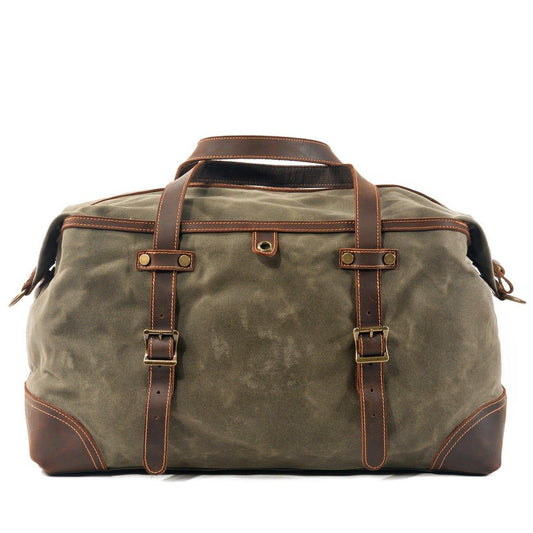
Lift the bag by its handles and inspect the points where webbing or leather meets the body. Reinforcement should distribute force over a broad area rather than concentrating it in a small patch. Pull gently in several directions and look for puckering, loose threads, or hardware that twists under load.
Backpack straps should attach at points that keep the bag close to the body. If the upper anchor sits too far out, the bag can pull backward; if the lower anchor is weak, it can create uncomfortable movement. Test the harness with a realistic packed load, not only empty.
Zippers, corners, and overpacking
Zippers often fail when a traveler tries to close an overfilled corner. Check whether the opening has enough room to accept the intended capacity and whether the zipper path bends smoothly around the ends. A protective flap can help, but it cannot compensate for constant pressure.
Pack shoes and dense objects away from zipper curves, use cubes to control soft clothing, and leave a little expansion room. If the slider catches, reduce the load instead of forcing it. A small daily habit can prevent a damaged tooth or split seam from becoming a trip-ending failure.
Base, abrasion, and dirty surfaces
The base meets airport floors, car trunks, station platforms, and sometimes wet ground. Check for a reinforced panel, protective feet, or a material that can tolerate wiping. Corners deserve particular attention because they receive both abrasion and impact when the bag is set down.
Use a clean mat or luggage rack when possible and remove grit before it works into fabric or zipper tracks. If the hybrid has a soft base, keep sharp equipment in a separate case and avoid dragging the bag when lifting is practical.
Hardware and conversion points
Buckles, rings, clips, and strap-storage panels are small parts with a large effect on usability. They should move without binding and remain secure when the bag changes from backpack to hand carry. Metal hardware should not create a hard pressure point against the back or the laptop compartment.
Practice the conversion with the complete load. A system that requires the straps to be folded sharply or tucked under tension may wear faster and be ignored in daily use. Simpler storage is often the more durable choice because it is more likely to be used correctly.
Maintenance that prevents early failure
Empty the bag after each trip, brush out grit, and inspect the high-load zones before storing it. Let damp fabric dry fully, condition leather components only as directed, and avoid packing the hybrid tightly for long periods. Storage is part of durability, not an afterthought.
Repair small loose threads or hardware movement early. Do not sew through a structural strap anchor without understanding the load path. If a seam is separating or a zipper is damaged, use an appropriate repair service before the next heavy trip.
Durability buying checklist
- Inspect strap anchors, handles, seams, zipper curves, and the base.
- Test conversion and balance with the realistic packed load.
- Avoid using capacity as permission to force the zipper closed.
- Choose hardware and strap storage that are simple to operate.
- Plan cleaning, drying, and inspection between journeys.


Durability should be assessed over the full life of a trip. At departure, the bag may be lifted from the floor with one hand; at the airport, it may be squeezed into a crowded overhead area; on arrival, the same bag may be worn for several blocks. Those transitions load the handles, shoulder anchors, zipper curves, and base in different directions. Pack so the heaviest objects are supported by the back panel or central base, not suspended from one outer pocket. Do not leave metal tools or shoes pressing against a seam. When the bag is used in backpack mode, secure loose webbing so it does not catch on doors or luggage belts. When it is used as a duffle, store the straps in the intended panel rather than folding them under the main load. These small choices reduce repeated stress and make the hybrid's versatility more sustainable.
Related Woosir resources
Use these related Woosir pages to compare current materials, dimensions, care details, and available variants before making a final decision.