Tactical Backpack vs Hiking Backpack: Which Wins for Outdoor Adventures in 2026?
Choosing between a tactical backpack vs hiking backpack is one of those decisions that looks simple until you are standing in a shop with two packs of the same volume and a wildly different price, weight and shape. Both promise to carry your gear across rough country. Both claim to be tough. Yet they are engineered around completely different assumptions about how a load should sit on a human body, how fast you need to reach your kit, and how much abuse the fabric will take. In 2026, with hybrid travel styles blurring the line between backcountry trekking, overlanding, urban commuting and disaster-prep, the answer depends far more on your actual use case than on the marketing photography.
This guide breaks down the real engineering differences, compares eight criteria that matter in the field, matches pack types to regions and trip lengths, and answers the questions people actually ask before they spend money. By the end you should know exactly which style belongs on your back — and when a third option, the classic waxed canvas or leather adventure pack, quietly beats both.
Tactical Backpack vs Hiking Backpack: The Short Answer
If you carry heavy loads over long distances on foot, a hiking backpack will make you happier within the first hour. If you carry moderate loads over shorter distances but need instant access, brutal abrasion resistance and modular attachment points, a tactical pack wins. Here is the comparison in one place.
| Criterion | Tactical Backpack | Hiking Backpack |
|---|---|---|
| Core design goal | Durability, modularity, fast access | Comfort and load transfer over distance |
| Typical fabric | 500D–1000D Cordura nylon | 100D–420D ripstop nylon |
| Empty weight (35L) | 1.6–2.4 kg / 3.5–5.3 lb | 0.9–1.6 kg / 2–3.5 lb |
| Frame | Framesheet, sometimes internal stays | Internal frame with load-transfer hipbelt |
| Opening style | Clamshell / panel loading | Top loading, often with side zip |
| External attachment | MOLLE/PALS webbing grid | Daisy chains, compression straps, loops |
| Comfortable load ceiling | 10–16 kg / 22–35 lb | 18–25 kg / 40–55 lb |
| Best distance range | Under 15 km per day | Multi-day, 15 km+ per day |
| Urban and travel discretion | Low — reads as military | Moderate — reads as outdoorsy |
Those numbers are averages across mainstream models, not absolutes. The important pattern is the trade-off: tactical packs buy toughness and modularity with weight, while hiking packs buy comfort and efficiency with more delicate fabric.
What Actually Makes a Tactical Backpack Tactical
The word gets thrown at any pack in coyote brown, but genuine tactical design has specific, testable features. Understanding them helps you spot a real performance pack versus a costume.
MOLLE and PALS webbing
The rows of horizontal nylon webbing stitched at fixed intervals are the defining feature. PALS (Pouch Attachment Ladder System) webbing lets you weave pouches, holsters, medical kits and water bottle carriers directly onto the pack surface, then reconfigure them in minutes. For someone whose kit changes between a day hike, a range day and a two-night overland trip, this modularity is genuinely valuable. The cost is weight — each row of webbing and its bar-tack stitching adds grams — and drag, because anything hanging off the outside catches on branches.
Heavy denier fabric
Tactical packs typically use 500D to 1000D Cordura nylon. Denier measures thread thickness, so higher numbers mean thicker yarn and better abrasion resistance. Drag a 1000D pack across granite and it scuffs; drag a 100D ultralight pack across the same rock and it can tear. This is why tactical packs survive being thrown into truck beds, dragged under fences and used as seats for years.
Administrative organisation
Clamshell openings, hook-and-loop admin panels, elastic keepers and dedicated document sleeves are standard. The philosophy is that you should be able to locate any item without unpacking the bag — the opposite of the top-loading hiking pack, where reaching the bottom means emptying the top.
Reinforced haul handles and hardware
Look for bar-tacked stitching at every stress point, YKK or Duraflex hardware, and a haul handle rated to lift the loaded pack repeatedly. These details are the difference between a pack that lasts a decade and one that fails at a seam in year two.
Where tactical design falls short
Hipbelts on tactical packs are often padded webbing rather than true load-transfer belts with a structured lumbar pad. That is fine for 10 kg, painful at 20 kg over eight hours. Ventilation is usually minimal because the back panel is designed to sit flat and stable. And in many countries, walking through a train station in full military-pattern kit invites attention you may not want.
What Makes a Hiking Backpack Different

Hiking packs are optimised for one measurable outcome: moving mass efficiently over distance with the least metabolic cost and joint strain.
Suspension and load transfer
A proper hiking pack routes 60–80% of the load through the hipbelt into your pelvis, the strongest weight-bearing structure in your body. That requires an internal frame — usually aluminium stays or a moulded HDPE framesheet — a load-lifter strap angle of roughly 45 degrees from the shoulder, and a stiffened lumbar pad. Get this right and 20 kg feels like 12. Get it wrong and 12 kg feels like 20.
Weight-to-volume efficiency
Hiking manufacturers obsess over grams because every gram of pack weight is a gram of food, water or shelter you cannot carry. A 60-litre trekking pack weighing 1.4 kg is a triumph of engineering. The compromise is thinner fabric that must be treated with a little more respect around abrasive rock and thorny scrub.
Ventilation and trampoline back panels
Mesh suspended back panels create an air gap between your spine and the pack body. In humid conditions — think summer in Southeast Asia or the American Southeast — this single feature transforms comfort. Tactical packs rarely offer it because a suspended panel moves the load away from your centre of gravity.
Adjustability and sizing
Serious hiking packs come in torso sizes or with an adjustable harness rail. A pack sized to your torso length, not your height, is the single biggest comfort variable. Tactical packs are usually one-size-fits-most with limited adjustment range.
Head to Head: Eight Criteria That Actually Matter
- Comfort under heavy load: Hiking pack wins clearly above roughly 15 kg. The hipbelt architecture is not optional at that weight.
- Abrasion and puncture resistance: Tactical pack wins. 1000D Cordura shrugs off rock, gravel and vehicle floors.
- Empty weight: Hiking pack wins, often by 700 g or more at the same capacity.
- Speed of access: Tactical pack wins. Clamshell openings and external pouches beat digging through a top-loader.
- Weather resistance: Roughly even. Hiking packs usually include a rain cover; tactical packs often use coated fabric and water-resistant zips. Neither is truly waterproof without a liner.
- Expandability: Tactical pack wins via MOLLE. Hiking packs expand with lid extensions and compression straps but far less flexibly.
- Airline and urban friendliness: Hiking pack wins on discretion; a slim 35–40L hiking pack passes as a carry-on almost anywhere, while a full MOLLE rig attracts questions.
- Cost per year of service: Roughly even. Tactical packs cost more up front but often outlive two hiking packs used hard.
Which Pack for Which Adventure, by Region
Terrain and climate change the calculus more than most buying guides admit. Here is how the tactical backpack vs hiking backpack decision plays out across the world.
Europe: hut-to-hut, cities and trains
Alpine hut trekking in Austria, Slovenia or Switzerland means moderate loads — no tent, no stove, sometimes no sleeping bag — over long days with big elevation gain. A 35–45L hiking pack is ideal. You will also be moving through train stations and small towns where a full tactical rig looks out of place. If your European trip mixes trail days with city nights, lean hiking or hybrid. For overlanding across the Balkans or vehicle-based trips in Scandinavia, tactical durability makes more sense because the pack lives in a vehicle and gets thrown around.
Asia: humidity, monsoon and dense cities
In Vietnam, Thailand, Indonesia and southern Japan, humidity is the enemy. A ventilated hiking pack with a trampoline back panel is worth its weight in dry shirts. Monsoon rain also means you need a genuine waterproof liner regardless of pack type — a dry bag inside beats a rain cover outside when the water arrives horizontally. In Nepal and northern India, where treks involve porters, teahouses and long ascents, a properly fitted hiking pack with a real hipbelt is non-negotiable. Tactical packs shine in Asia mainly for motorcycle touring, where the abrasion resistance and lash points earn their keep.
The Americas: backcountry distance and desert abrasion
North American backcountry travel often means carrying multi-day food, bear canisters and full water loads. That pushes weights past 18 kg, which is hiking-pack territory without debate. The desert Southwest, Patagonian scrub and Mexican canyon country all punish thin fabric, so if your routes involve slot canyons, scrambling or cactus, a mid-denier hiking pack or a tactical pack with a proper belt is the smarter buy. For overlanding and truck-based camping across the Americas, tactical packs are the practical choice.
Capacity Guide: Matching Litres to Trip Length
- 15–25L: Day hikes, urban carry, range days, EDC. Either style works; tactical excels for organisation.
- 26–40L: Overnight trips, fast-and-light two-day routes, one-bag air travel. The most versatile band and the sweet spot for hybrids.
- 41–55L: Two to four nights with a tent, or a week in huts and hostels. Hiking suspension starts to matter a great deal.
- 56–70L: Extended backcountry, winter kit, expedition support. Hiking packs only — no mainstream tactical pack carries this comfortably.
- 70L+: Specialist expedition and porter loads. Look for dual aluminium stays and a fully adjustable harness.
Fit and Sizing: The Step Most Buyers Skip
Torso length, not height, determines pack size. Measure from the C7 vertebra — the bump at the base of your neck when you tilt your head forward — to the imaginary line across the top of your hip bones. Most adults fall between 41 cm and 53 cm (16–21 inches). Short torso means a small or medium pack even if you are tall; long torso means a large even if you are not.
When you try a loaded pack, look for four things: the hipbelt centred on the iliac crest and carrying most of the weight, shoulder straps that wrap without gapping, load lifters at a 45-degree angle, and a sternum strap that stabilises without compressing your chest. If you feel the load pulling backwards from your shoulders, the torso length is wrong or the load lifters are not doing their job.
The Third Option: Waxed Canvas and Leather Adventure Packs
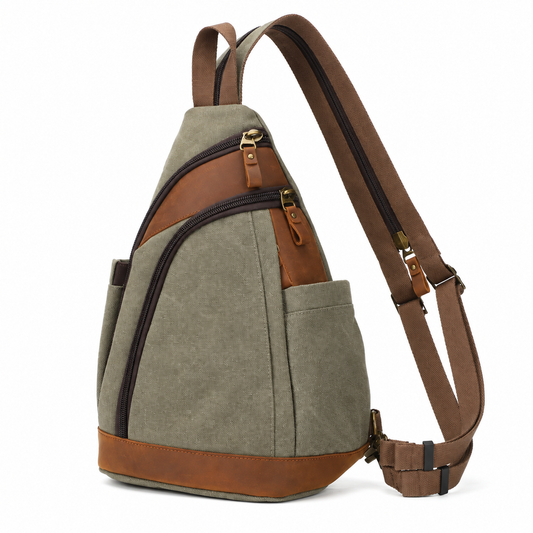
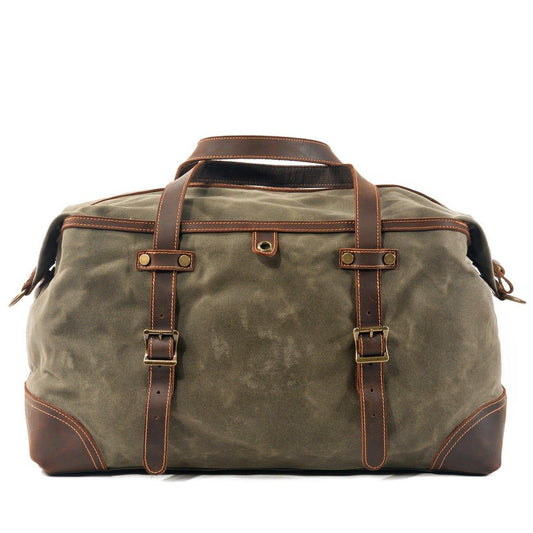
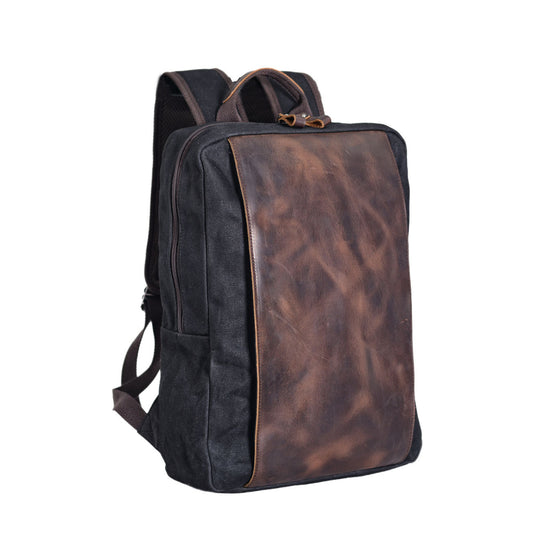
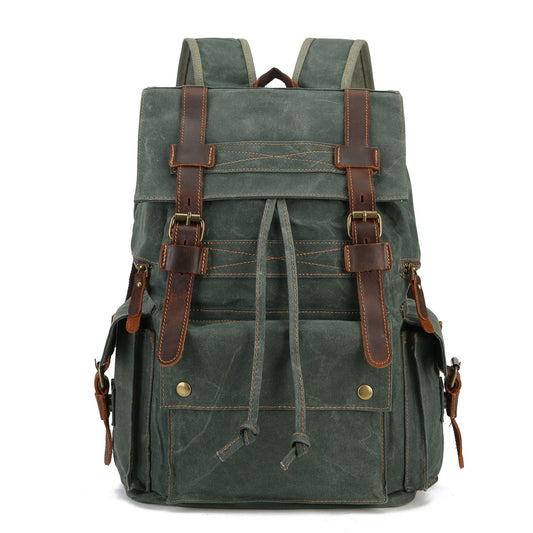
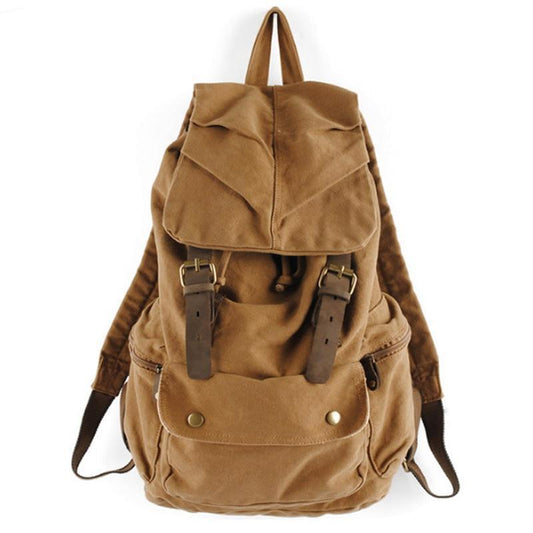
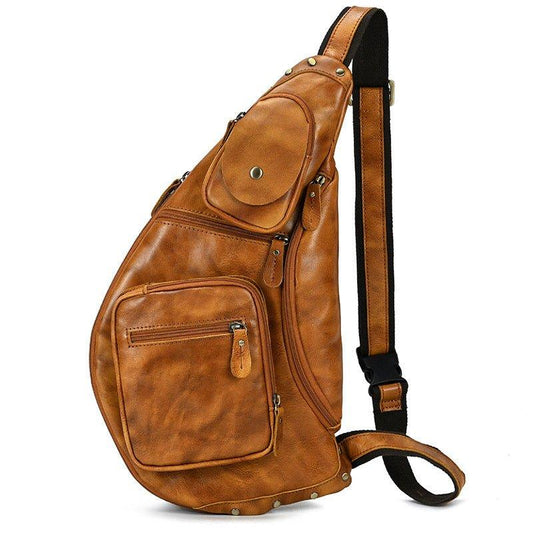
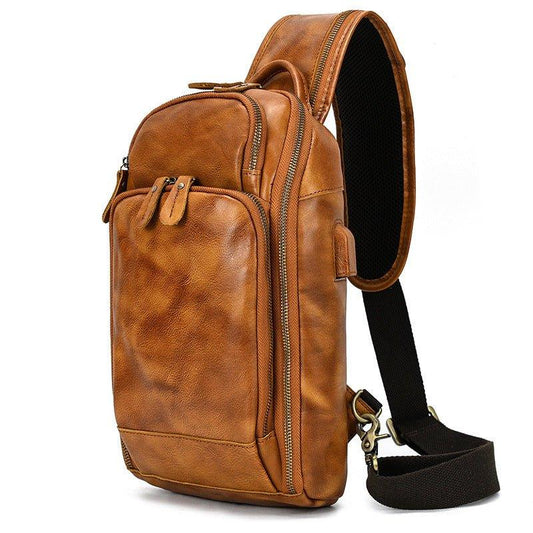
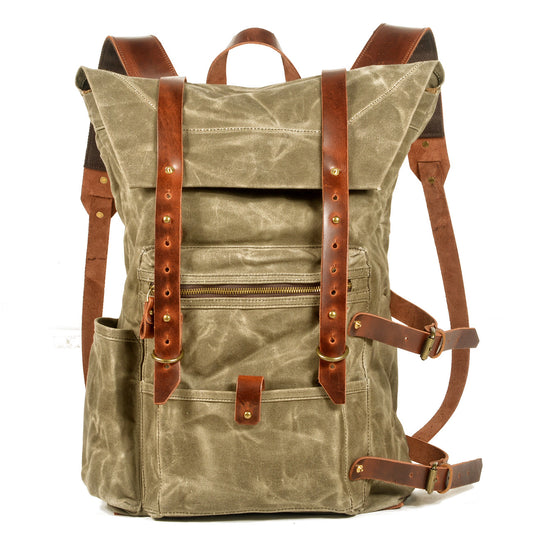
There is a category most comparisons ignore: the heritage-material pack. A waxed canvas rucksack with leather reinforcement sits between the two extremes. The canvas is genuinely tough and naturally water-resistant, the leather base resists abrasion where it matters, and the aesthetic works in a mountain village, a hotel lobby and a boardroom without adjustment.
These packs will not replace a 65L trekking pack for a week in the mountains, and they are heavier than nylon at the same volume. But for the traveller doing two nights hiking, three nights in cities and a flight home, they solve a real problem: one bag that never looks wrong. If that is your pattern, browse the waxed canvas bags collection for weather-ready options, or compare purpose-built trail models in the hiking backpack range. For MOLLE-equipped and field-ready designs, the tactical bags collection covers the modular end of the spectrum.
Care and Maintenance: Making Either Pack Last a Decade
- Empty and dry after every trip. Trapped moisture degrades polyurethane coatings faster than any amount of use.
- Wash by hand, never in a machine. Cool water, mild soap, soft brush. Machine agitation destroys frames and coatings.
- Lubricate zips. A candle stub or dedicated zip wax on the teeth twice a year prevents the most common failure point.
- Re-wax canvas annually. If you go the heritage route, a yearly wax treatment restores water resistance and keeps fibres supple.
- Condition leather trim. Twice a year with a neutral cream stops cracking at buckle points.
- Store loosely stuffed. Hanging a compressed pack for months creases coated fabric permanently.
Common Mistakes to Avoid
Buying capacity you do not need. A bigger pack gets filled. Buy for your typical trip, not your imagined expedition.
Judging comfort in an empty pack. Always load the demo pack with at least 10 kg. Every pack feels fine empty.
Assuming water resistance means waterproof. No zip-closed pack survives sustained rain. Use a liner or dry bags for anything that must stay dry.
Hanging too much off MOLLE. External pouches shift your centre of gravity backwards and snag constantly. Keep dense items inside and close to your spine.
Ignoring airline dimensions. If the pack will fly, check that the loaded profile fits within roughly 55 x 40 x 20 cm before you commit.
Frequently Asked Questions
Is a tactical backpack good for hiking?
For day hikes and overnight trips under about 15 kg, yes — a tactical backpack handles hiking well and its durability is an advantage on rocky terrain. Beyond that weight, the lack of a true load-transfer hipbelt causes shoulder and lower-back fatigue, and a hiking backpack becomes the better tool.
Can I use a hiking backpack for everyday carry?
Yes, especially in the 20–30L range. The downside is organisation: top-loading hiking packs make it awkward to grab a laptop or documents quickly. Look for a model with a side zip or a dedicated front panel pocket if daily use matters.
What does denier mean and how much do I need?
Denier measures the thickness of individual fibres in the fabric. For general hiking, 210D–420D is a good balance of weight and durability. For rough handling, vehicle travel or heavy scrub, 500D–1000D is worth the extra weight. Below 100D you are in ultralight territory, which demands careful handling.
Are tactical backpacks allowed as airline carry-on?
Dimensionally, most 25–35L tactical packs fit standard carry-on limits. The practical issues are appearance and contents — remove any knives, multi-tools with blades, and anything resembling ammunition or restricted gear. In some countries, military-pattern bags attract additional screening. A neutral colourway avoids most of this friction.
Which pack is better for motorcycle and overland travel?
Tactical, in most cases. Abrasion resistance, lash points and compression matter more than metabolic efficiency when the vehicle carries the weight. Water resistance is critical too, so pair it with a waterproof liner.
How much should I spend?
Expect meaningful quality to start around the mid-range in both categories. The markers of value are the same regardless of style: YKK zips, bar-tacked stress points, a frame appropriate to the volume, and a manufacturer that sells replacement buckles and belts. A pack you use fifty days a year for ten years costs very little per outing.
Can one pack really do everything?
Close, but not quite. A 35–40L pack with a real hipbelt, moderate-denier fabric and clean styling covers roughly 80% of adventures — day hikes, overnights, flights and city travel. The remaining 20% (long expeditions at one end, minimalist trail running at the other) genuinely needs a specialist tool.
The Verdict
The tactical backpack vs hiking backpack question has no universal winner, only a correct match between design philosophy and use case. Choose a hiking backpack when distance, load and comfort dominate: multi-day trails, heavy water carries, big elevation, humid climates. Choose a tactical backpack when durability, modularity and rapid access dominate: vehicle-based travel, motorcycle touring, range and field days, shorter walks with awkward kit. And if your adventures blend trail, town and terminal in the same week, consider a waxed canvas or leather hybrid that carries competently and looks right everywhere.
Whichever direction you go, the fundamentals do not change. Buy for your real trips rather than your aspirational ones, fit the pack to your torso rather than your height, test it loaded before you commit, and maintain it properly. Do that and a single well-chosen pack — tactical, hiking or heritage — will carry your gear across continents for the next decade.